Low Taper Fade: The Ultimate Barber Guide
If you want a professional, sharp haircut that does not expose too much skin, this is the exact style you need. The low taper fade is an option for keeping the blend close to the edges. Because it leaves the majority of the hair on the sides of the head intact, it provides a clean, polished look that fits flawlessly into both corporate environments and casual settings. If you are tired of high-and-tight military cuts and want something that frames your face perfectly, this comprehensive guide breaks down every length, hair texture, and styling technique you need to know.
What is a Low Taper Fade Haircut?
A low taper fade keeps the shortening low around the sideburns and neckline, retaining more length above. The shortest section can finish at skin or retain some hair, depending on the version you request.
Unlike a standard fade that cuts a horizontal ring all the way around the head, this variation sits extremely low and isolated. The faded section usually stays within a single inch of the ear cartilage. Consequently, this leaves a significant amount of weight and hair volume across the parietal ridge. This provides the clean, lined-up edges of a fresh cut while maintaining the natural shape and flow of your hair. If you need a refresher on the base mechanics, you can read our foundational taper fade guide.
Low Taper Fade vs. Mid and High Tapers
When you sit in the barber chair, choosing the correct fade height determines the entire geometry of your haircut.
- Low Taper: Keeps the skin line below the top of the ear. This preserves maximum hair weight on the sides, adding width to your profile.
- Mid Taper: Pushes the fade up to the temple area, exposing roughly half of the side of the head to the skin. It balances contrast and length.
- High Taper: Pushes the fade up to the hairline corners. It removes almost all the bulk from the sides, aggressively slimming down the face.
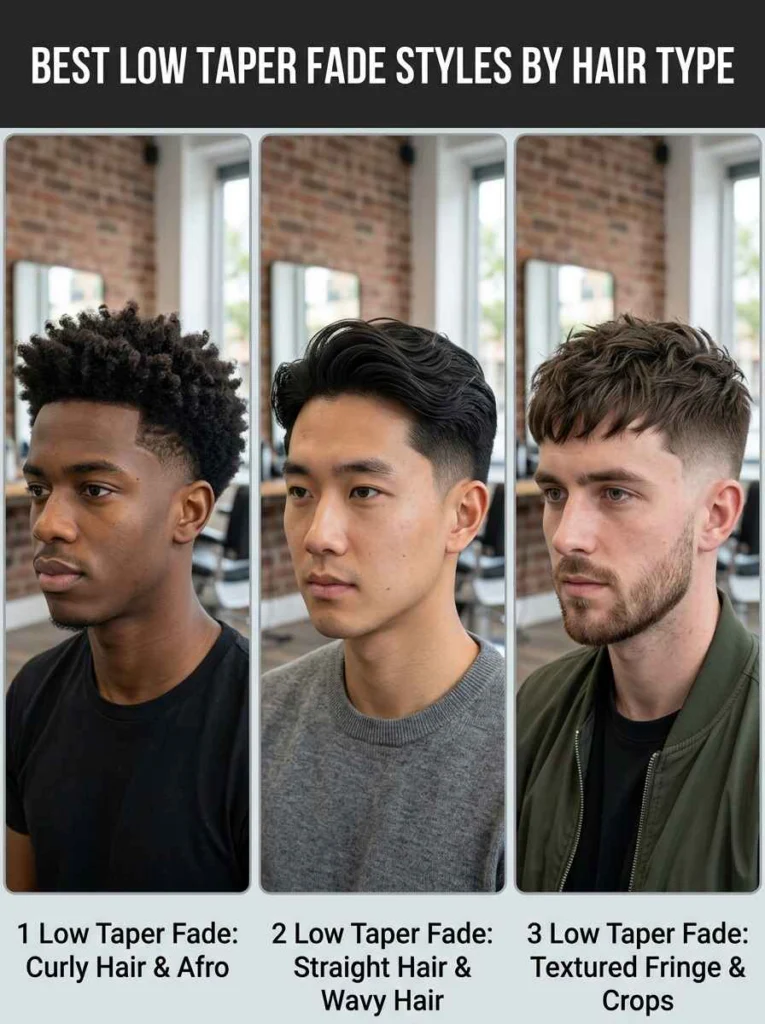
Best Low Taper Fade Styles by Hair Type
This haircut can be adapted to different textures and face proportions. Discuss the top shape and side fullness rather than assuming one version suits everyone.
Low Taper Fade Curly Hair & Afro
Curls need physical weight and structural support to form properly. By keeping the fade low, you allow the sides to remain thick enough to support the curls dropping naturally over the temple. A low taper fade with curly hair is incredibly popular because it prevents the awkward “mushroom” effect that happens when curly hair is cut too high on the sides. For tightly coiled hair, a low fade combined with a sponge-twisted afro creates an immaculate, sharp contrast at the neckline while preserving volume.
Low Taper Fade Straight Hair & Wavy Hair
Straight and wavy hair textures often lay flat without intervention. To fix this, barbers will heavily layer the top. A low taper fade straight hair style relies on texturizing shears and matte clay to build upward volume, contrasting sharply with the tight clipper work at the sideburns.
Low Taper Fade with Textured Fringe & Crops
If you have straight or slightly wavy hair, the messy fringe and textured crop are currently the biggest trends in men’s grooming. The barber heavily layers the hair on top and pushes it forward to rest over the forehead. The tight low taper fade at the sideburns creates a sharp, clean perimeter that prevents the forward-swept fringe from looking messy or unkempt.
Executive & Professional Variations
For men who need a haircut that works seamlessly in a corporate boardroom, the low taper fade offers unmatched versatility.
- The Executive Classic (Side Part): A clean side part on top combined with a subtle fade just above the ears. It is the gold standard for polished, professional style.
- Slicked Back Low Taper: Ideal for formal settings. You maintain length on top and use a lightweight pomade to sweep it straight back. The tight sideburns keep the look modern and prevent the slick-back from looking like an outdated greaser style.
- Low Taper Curtains: A middle part that frames the face with soft layers. The low fade keeps the edges sharp while the longer “curtains” provide a relaxed, effortless flow.
Top Short Length Variations
You do not need long hair on top to pull off this aesthetic. Here is how barbers adapt the cut for shorter lengths.
Low Taper Fade Buzz Cut
For an ultra-low maintenance routine, combining a #2 or #3 guard buzz cut with this fade creates a highly athletic, military-inspired look. The low taper fade buzz cut keeps the top completely uniform while dropping the sideburns and neck down to the bare skin, adding a highly engineered finish to an otherwise basic haircut.
Low Taper Fade Black Male Styles
For deeply textured, coarse hair, this cut is a barbershop staple. The barber lines up the natural C-cup of the hairline with a straight razor, then drops the fade strictly at the sideburn and nape. A low taper fade black male style pairs perfectly with short 360 waves, providing a razor-sharp edge without cutting into the wave pattern.
Face Shape & Hair Density Guide
Because this specific fade leaves thick hair on the sides of the head, it alters your visual silhouette.
- Oval and Long Faces: The extra hair behind the ear adds width to the head, perfectly balancing out a longer face.
- Diamond Faces: It softens sharp cheekbones by filling in the space around the temples.
- Round Faces: Leaving heavy bulk on the sides makes a round face look wider. If you want a narrower-looking silhouette, discuss reduced side bulk or additional top height. A low taper can still work when its overall shape suits your preferences.
- Lower Hair Density (Thinning Hair): This cut is incredibly forgiving for men with lower hair density. Because it does not expose the scalp high up on the sides, it avoids the “balding” look that high fades often accidentally highlight.
The Barber Chair Checklist: Requesting Your Cut
To get exactly what you want, you need to use the correct terminology. Use this checklist during your next consultation to ensure a flawless low taper fade.
- Specify the height: Explicitly state the haircut name. Tell them you do not want the clippers going higher than the top of your ear cartilage.
- Choose your clipper guard: If you do not want a bald skin fade, ask your barber for a #2 guard that tapers down to the neckline. This leaves about 0.25 inches of hair at the shortest point.
- Address the neckline: Confirm that you want the back faded low as well, keeping the natural, square or rounded hairline shape intact.
- Discuss the top: Ensure the barber understands your natural hair growth patterns. Ask for texture and point-cutting if you have straight hair, or bulk-removal if your hair is extremely thick.
Hair Care & Maintenance Routine
A fresh fade looks terrible if your hair is dry and your scalp is unhealthy. Follow this maintenance routine to extend the life of your cut.
- Washing Frequency: Wash according to scalp oiliness, dirt and product buildup rather than a fixed schedule. AAD hair-care guidance explains why washing needs differ by hair type.
- Brushing: Use a boar bristle brush to distribute natural oils from the root to the tip of the hair, keeping the longer sections healthy.
- Product Selection: Avoid heavy, shiny gels that cause buildup and dull the fade’s contrast. Use a lightweight sea salt spray for natural volume, or a dry matte clay for hold without a greasy finish.
Regrowth Timeline
Knowing when to rebook your barber is critical for keeping this style sharp.
- Days 1 to 7: The fade remains immaculate. The skin contrast is highly visible.
- Days 8 to 14: Stubble begins to form on the sideburns and neck. The sharp transition softens into a shadow.
- Days 15 to 21: The blend may lose contrast as the short sections grow. Treat these ranges as examples; book a touch-up when the outline no longer matches the finish you prefer.
Frequently Asked Questions
Can I get a low taper fade with a receding hairline?
A low taper can retain side fullness, but coverage depends on your density, hairline and top length. Ask your barber to assess the dry result; a haircut changes appearance and does not treat hair loss.
Does this cut work well with a beard?
Absolutely. The barber will perfectly blend the sideburn fade downward directly into your facial hair. This creates a highly engineered, disconnected look that makes your beard appear thicker and more structured.