Taper Fade Curly Hair: 9 Best Styles for Men
Curly hair already has shape and movement, so a good taper does not need to compete with it. The cleaner the transition around the temples and neckline, the more noticeable the curls on top tend to become.
That is the basic appeal of a taper fade with curly hair: you can sharpen the outline of the haircut without taking away the texture that gives it character.
Where people usually go wrong is choosing the cut only from a photo. Curl tightness matters, but so do density, shrinkage, top length, and how much contrast you actually want between the top and sides.
A loose, longer curl may need room to bend before it looks right. Tight curls can hold a strong shape at a much shorter length. Thick hair may need weight removed carefully, while finer curls can look flatter if the sides are taken too high.
So before deciding on a style name, decide what you want the haircut to do.
What Is a Curly Taper Fade?
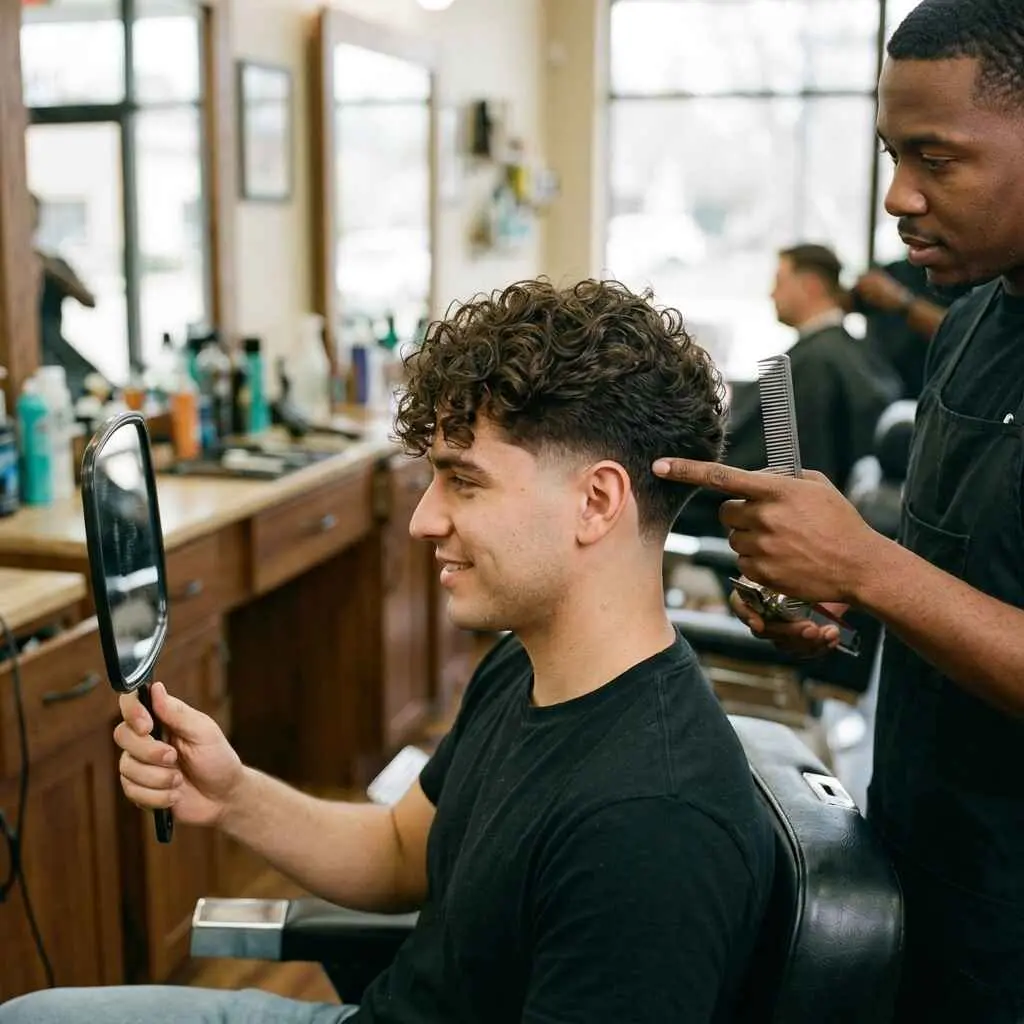
A curly taper fade keeps most of the natural texture on top while gradually shortening the hair around the edges of the haircut.
The taper usually shows most clearly around the temples, sideburns, and neckline. Instead of removing a large section of the sides, the barber creates a cleaner transition near those areas and leaves the curls above them with more presence.
That is why this cut works so well when you want your curls to remain the main feature.
You may hear barbers use “taper,” “fade,” and “taper fade” differently. Terminology is not perfectly consistent from shop to shop, so the safest approach is not to rely on the name alone.
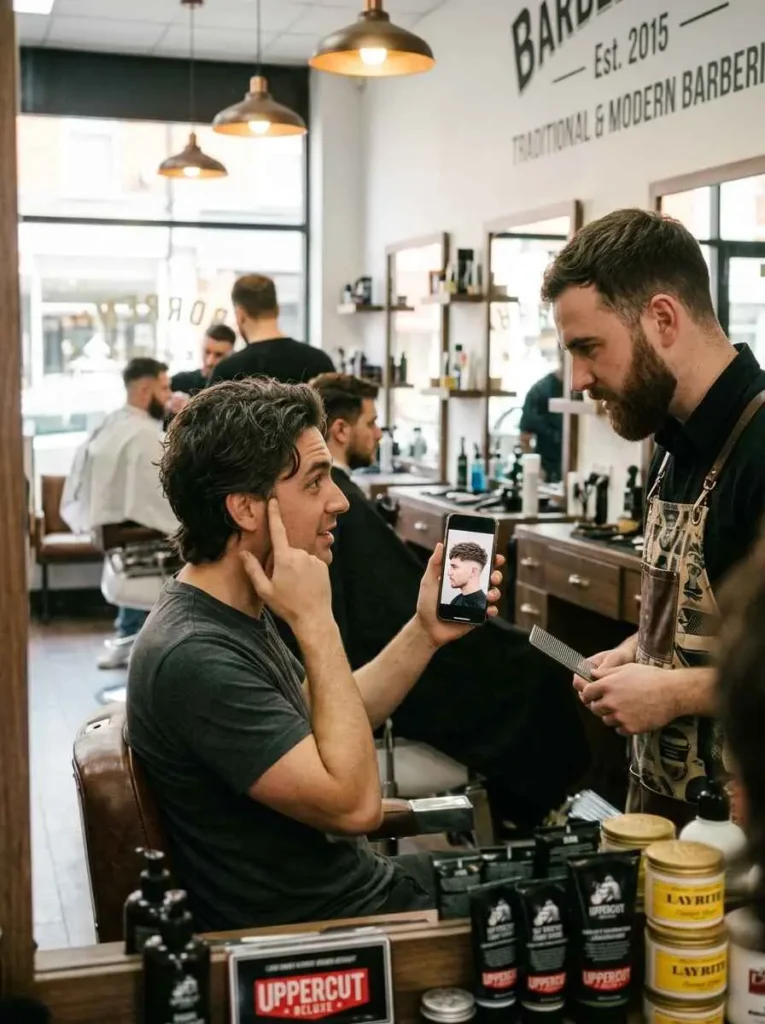
Show the barber a photo. Point to where you want the shorter area to start. Then explain how much curl you want to keep on top.
That conversation is usually more useful than knowing the “correct” haircut label.
Before Choosing a Style, Look at Your Own Hair
A haircut photo can tell you whether you like a shape. It cannot tell you whether your hair will behave the same way.
A few details make a much bigger difference than people expect.
Loose curls usually need some length
If your curls are loose, cutting the top too short can change the whole appearance of the haircut. Instead of seeing a defined curl, you may end up with something that reads more like short wavy texture.
That does not mean loose curls need to stay long. It simply means there needs to be enough length for your curl pattern to show.
Tight curls create shape faster
Tighter curls and coils usually show visible texture at shorter lengths. They can also create more density around the top and sides.
Here, the barber’s job is often less about “making the hair curly” and more about deciding where that density should sit.
A clean taper can make the top look more defined without removing the fullness that gives the haircut its shape.
Density changes the silhouette
Two people with a similar curl pattern may still need different cuts.
Very dense hair can build width quickly around the sides. Finer curls may need more of that side weight preserved.
This is why copying another person’s exact taper height does not always work.
Shrinkage matters before the first cut is made
Curly hair can appear noticeably shorter after drying.
If your hair shrinks a lot, tell the barber before they start taking length from the top. It is much easier to remove a little more hair at the end than to replace length that disappeared once the curls dried.
Low, Mid, or High Taper?
You do not need a complicated rule for choosing taper height.
Think about contrast.
| Taper | Overall effect | Makes sense if you want |
|---|---|---|
| Low | Soft, subtle transition | More fullness left around the sides |
| Mid | Noticeable but balanced | A cleaner shape without a dramatic jump |
| High | Stronger separation | More contrast between the curls and sides |
A low taper keeps more of the side profile intact, so the haircut tends to feel softer.
Move the taper higher and the contrast becomes more obvious. That can make the curly top look bigger even when the actual top length has not changed.
We already cover these cuts separately in the Low Taper Fade, Mid Taper Fade, and High Taper Fade guides. Those pages are the better place to go if taper height itself is the main decision you are trying to make.
Here, the more useful question is how that taper works with the curls above it.
Best Taper Fade Curly Hair Styles for Men
A lot of hairstyle lists turn one haircut into twenty names. Changing the direction of a few curls does not always make it a new style.
These variations create a more noticeable difference in shape, length, or finish.
Classic curly taper fade
If you do not want anything extreme, start here.
The top keeps a natural amount of curl, the sides stay relatively full, and the taper simply cleans up the outer edges.
It is the kind of curly taper fade haircut that does not depend on heavy styling to make sense. Let the curls sit naturally and the taper does the cleanup work.
For a first curly taper, this is often easier to communicate to a barber than a more exaggerated reference.
Loose curl taper fade
A curly loose curl taper fade needs enough hair on top for the bend of the curl to remain visible.
Take that length away and the defining part of the style disappears.
The taper itself can stay fairly subtle. The movement on top already creates visual interest, so there is no need to make the sides extremely aggressive unless you specifically want that contrast.
Defined curls with clean edges
This version puts more emphasis on curl separation.
The top is shaped so the curl groups are easy to see, while the temples and neckline stay sharp enough to frame them.
The biggest mistake here is choosing a reference photo with a curl pattern completely different from your own. A barber can reproduce the general silhouette, but the texture will still behave like your hair.
Use the photo as a shape reference, not a promise of an identical result.
Curly top taper fade
A curly top taper fade keeps more height or fullness above the shorter edges.
This can look bold without requiring the sides to be taken down like a full high fade.
How the top is shaped changes the character of the cut. Rounder curls make the silhouette softer. Wearing them higher creates more vertical volume. Letting them lean forward gives the haircut a looser finish.
If the top is already dense, ask the barber to shape the bulk instead of simply thinning it everywhere.
Curly fringe taper fade
With a curly fringe taper fade, some of the curls are left to fall toward the forehead.
The result feels different from a tall curly top because the volume moves forward instead of upward.
Fringe length deserves a little caution. Wet curls can hang farther down than they will once dry, so judge the final length by how your hair normally sits rather than by what it looks like immediately after being sprayed with water.
Short curly taper
Some people want the texture without keeping much length.
A short curly taper does exactly that. The curls stay visible, but there is less bulk to shape and less hair to deal with during daily styling.
The only real trade-off is obvious: go too short and the curl pattern may stop being the main feature.
If that texture is the reason you chose the haircut, leave enough of it to see.
Long curly top with a taper
This is almost the opposite approach.
Instead of making the taper the focus, you let the top carry most of the haircut. Longer curls can fall forward, sit naturally, or be shaped upward depending on the pattern.
The taper keeps the perimeter from becoming too heavy.
With this version, overall shape matters more than having every curl perfectly controlled. A good cut should still look intentional on days when you do not spend much time styling it.
Natural, messy curly taper
Not every curly style needs a glossy, separated finish.
A looser top can work well when the temples and neckline are neat enough to create contrast.
This is especially useful if your hair already falls into a shape you like. Instead of fighting that movement every morning, let the haircut support it.
Curly taper with a line-up
A line-up changes the feel of the haircut more than the curls themselves.
Sharper edges around the front and temples create a more precise finish. Leaving the natural hairline softer gives the same curly top a more relaxed look.
Neither approach is necessary for the taper to work. It is simply a finishing choice.
Make that choice before the barber starts shaping the front.
Which One Fits Your Hair?
If all the style names are starting to blur together, ignore them for a moment.
Look at your hair instead.
| Your hair | What deserves attention |
|---|---|
| Loose curls | Keeping enough top length for the curl to form |
| Tight curls | Managing density without flattening the shape |
| Coils | Allowing for shrinkage and preserving the silhouette |
| Very dense hair | Removing bulk carefully rather than thinning everywhere |
| Finer curls | Avoiding so much side removal that the top looks isolated |
| Longer curls | Keeping the perimeter neat enough to balance the volume |
This is more useful than trying to match yourself to a rigid curl chart.
Hair charts can describe texture. They cannot decide the whole haircut for you.
What to Tell Your Barber
You do not need to give your barber a technical speech.
You do need to be specific.
Start with the photo you want to use as a reference. Then clarify four things:
Where should the taper sit?
Point to the area if necessary. Do not assume “low” or “mid” means exactly the same thing to every barber.
How much length are you keeping?
Show where you want the top to sit when dry, especially if your curls shrink noticeably.
What shape do you want on top?
Rounded? Forward? Taller? Loose and natural? A fringe?
What kind of hairline do you prefer?
Natural, cleaned up, or sharply lined?
That is enough to remove most of the ambiguity.
If your hair behaves very differently wet and dry, mention that too. The final haircut has to work after you leave the chair, not just while the hair is damp.
Styling Does Not Need to Be Complicated
The taper itself does not require much styling. The curls do.
For many people, a simple routine is better than layering several products on top of each other.
Start with hair that has some moisture in it. If your curls feel dry or lose definition easily, a leave-in conditioner or curl product can help. Use enough to control the hair without making it heavy.
Then shape the curls with your fingers and give them time to dry.
Dermatologists at the American Academy of Dermatology note that curly and coily hair can be more prone to dryness and breakage. They also recommend avoiding aggressive dry brushing and handling the hair gently when detangling.
Heat deserves the same common-sense approach. A diffuser or blow dryer is not automatically a problem, but excessive heat can damage hair. The AAD recommends limiting heat exposure and using lower settings when possible.
If your curls already look good after air-drying, there is no prize for making the routine more complicated.
Keeping the Taper Fresh Is Different From Caring for the Curls
These are two separate maintenance jobs.
The short hair around the temples and neckline usually loses its crispness before the top actually needs reshaping. How soon that bothers you depends on how fast your hair grows and how sharp you like the taper to look.
There is no useful universal rule saying everyone needs a cleanup after a specific number of days.
Watch the outline of the haircut. When it no longer looks the way you want, it is time.
The curls need a different kind of attention.
Conditioning, gentle detangling, and sensible heat use matter more than constantly restyling them. The AAD recommends conditioner for curly hair and says thick, curly hair is best combed gently with a wide-tooth comb while wet or damp rather than handled roughly.
If you use creams, gels, oils, or pomades regularly, also pay attention to buildup. Adding another layer of product is not always the solution when the hair stops behaving well.
A Few Mistakes Are Easier to Avoid Before the Cut
The first is choosing a haircut only because the photo looks good.
Look at the person’s curl pattern, density, and top length. If all three are very different from yours, expect a different result.
Another common mistake is treating shrinkage as an afterthought. Once too much length is gone, styling cannot put it back.
Heavy thinning deserves caution for the same reason. Dense curly hair sometimes needs weight removed, but removing bulk everywhere can change the way the curls group and sit.
Then there is the simplest mistake of all: asking only for “a taper.”
That still leaves the barber guessing about height, contrast, top shape, fringe length, and hairline finish.
A photo plus a few clear instructions takes less than a minute and gives the barber much more to work with.
Frequently Asked Questions
Does a taper fade work with naturally curly hair?
Yes. A taper can clean up the temples and neckline while leaving most of the natural curl pattern visible on top. The result depends on how much length and side volume you keep.
How long should the curls stay on top?
Long enough to create the shape you want. Loose curls often need more length before they form clearly, while tighter curls and coils can show plenty of texture at shorter lengths.
There is no single ideal measurement for everyone.
Should curly hair be cut wet or dry?
Both approaches are used. What matters most is that the barber understands how your hair behaves after it dries and accounts for shrinkage before removing too much length.
How often should I get the taper cleaned up?
When the temples and neckline stop looking as sharp as you want them to. Growth rate and personal preference vary too much for one schedule to make sense for everyone.
Can tight curls and coils get a taper?
Absolutely. The main concern is preserving enough top density and accounting for shrinkage so the shorter edges still blend naturally into the texture above them.
The Simple Way to Choose
Do not start with the haircut name.
Start with your own hair.
Decide how much curl you want to keep, how much side volume you are comfortable losing, and whether you want the taper to look subtle or obvious. Find a reference with a texture reasonably close to yours, then use that photo to talk through the details with your barber.
The taper should frame your curls.
It should not erase what made you choose a curly haircut in the first place.