Burst Taper Fade: The Ultimate Barber Guide
When you want a haircut that stands out from the standard crowd, you have to change the geometry of the fade. The burst taper fade is one of the most technically difficult cuts a barber can execute, but when done correctly, it provides an incredibly unique, rounded silhouette. Instead of dropping the fade down the neck, the clippers create a perfect semi-circle around the ear. If you are tired of standard fades and want something highly modern and athletic, this guide will walk you through everything you need to know.
What is a Burst Taper Fade?
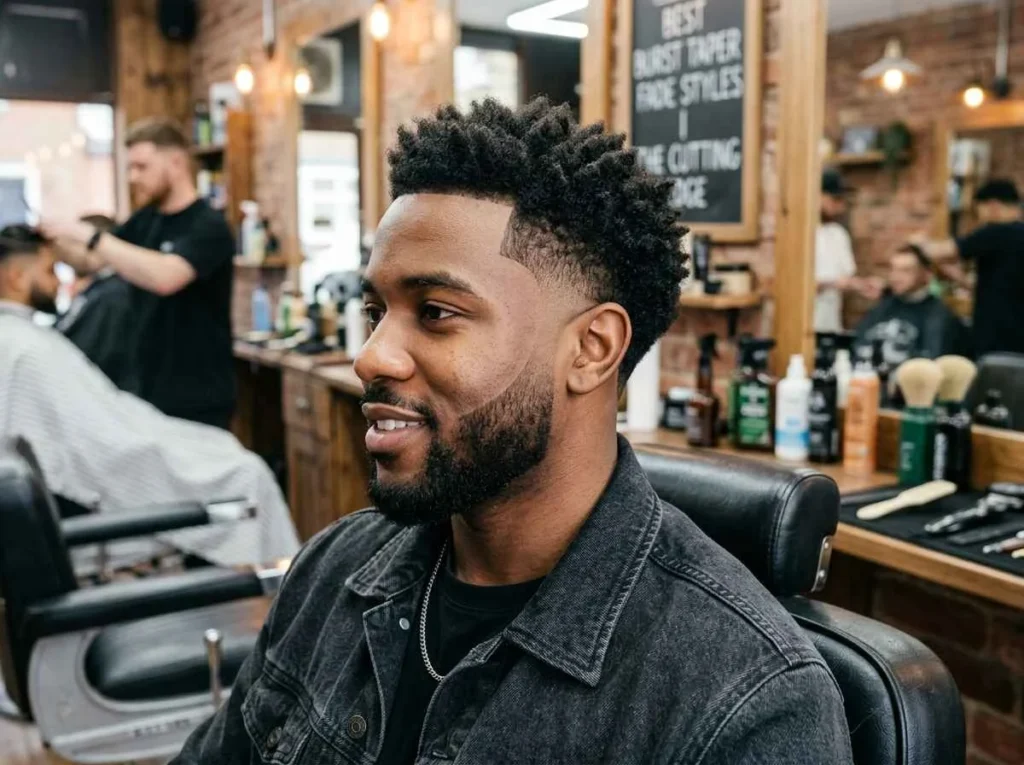
A burst taper fade is a precise haircut technique where the fade is carved in a circular, sunburst pattern directly around the ear, leaving the hair at the neckline long and wide.
Unlike a standard fade that cuts horizontally across the back of the head, the fade stops abruptly behind the ear. As a result, the hair at the nape of the neck remains thick, creating a wide strip of hair that drops down your neck. Because the clippers form a perfect arch, the fade appears to radiate outward from the ear. This cut is highly popular among athletes and pairs exceptionally well with textured, curly, or braided hair on top.
Best Burst Taper Fade Styles
This haircut is highly versatile and works with several distinct top styles. Here are the most popular variations requested in barbershops today:
- Burst Fade Taper Faux Hawk Back: This is the most famous variation. The barber leaves a wide strip of thick hair running from the forehead all the way down to the base of the neck. Because the sides are faded in a circle, it creates a wide, aggressive faux hawk profile.
- Low Taper Burst Fade: If you want a more conservative look, the low variation keeps the circular fade very tight around the ear cartilage. It removes minimal bulk from the sides, making it a great option for men with longer, flowing hair.
- Mid Taper Burst Fade: This is the standard approach. The semi-circle pushes higher up the temple, creating a massive amount of contrast between the skin and the hair on top.
Burst Taper Fade vs. Mullet
Many clients confuse this cut with a mullet because both styles leave the hair long on the back of the neck. However, they are structurally very different.
With a typical mullet, the barber only fades the sideburns in a straight, vertical line. The hair directly above the ear remains long. By contrast, a burst taper fade actively removes all the hair around and directly behind the ear in a rounded shape. Therefore, this cut looks much cleaner and more athletic from a side profile, whereas a mullet looks intentionally retro and disconnected.
What to Tell Your Barber for a Burst Taper Fade
Because this cut requires advanced clipper mechanics, you must communicate your goals clearly to avoid a botched fade.
- Ask for the semi-circle: Explicitly use the term “burst fade.” Tell the barber you want a rounded arch around the ear, not a drop fade that crosses the back of the head.
- Define the width of the back: Tell them how wide you want the hair on your neck to be. You can request a narrow, V-shaped point at the neck, or leave it wide and square.
- Specify the skin line: Confirm if you want the burst taken completely down to the skin with a foil shaver, or if you want a slight shadow left with a #1 guard.
- Discuss the top texture: Make sure the barber cuts the top to match your natural hair growth patterns, heavily texturizing it so it naturally flows into the back section.
Frequently Asked Questions
Does a burst taper fade work with straight hair?
Yes, but it requires more styling effort. Straight hair tends to stick straight out when cut short. You will need a strong matte clay to push the top hair toward the middle to create the faux-hawk shape.
How often do I need to maintain a burst fade?
Because the circular shape is highly geometric, it looks messy very quickly as it grows out. You must visit the barber every 14 days to keep the arches sharp and clean around the ear.
Can I get a burst taper fade with a beard?
Absolutely. The barber will fade the bottom of the sunburst directly into the sideburns, creating a seamless, sharply disconnected transition into your facial hair.