Mid Taper Fade: 9 Flawless Styles & Ultimate Execution Guide
Precision barbering relies on balance, and the mid taper fade represents the exact equilibrium between sharp skin exposure and retained crown volume. Positioned precisely at the midpoint of the temporal bone and occipital base, this cut clears the perimeter of the ears without encroaching upon the upper silhouette. Whether paired with sweeping flow on straight strands or textured volume on tight coils, mastering this aesthetic requires understanding hair mechanics, graduation lines, and proper salon communication.
Anatomy of the Mid Taper Fade Haircut
A foundational taper fade haircut isolates clipper graduation to two specific zones: the temporal region in front of the ear and the lower nape at the base of the skull.
Unlike a continuous circular skin fade, the hair surrounding the posterior ear cartilage remains intact. When executing a mid taper fade haircut, the skin exposure initiates roughly one to one-and-a-half inches above the sideburn base, smoothly blending upward toward the parietal crest. This geometry establishes distinct visual contrast:
- Temporal Cleanliness: Eradicates sideburn bulk, defining facial contours and jawline structure.
- Posterior Weight Preservation: Retains density around the mastoid area, preventing an overly exposed or hollow profile.
- Nape Tapering: Transitions the collar perimeter down to bare skin, creating a spotless neckline that physically elongates the neck.
Structural Comparison: Fade Heights & Silhouette Dynamics
Selecting the correct elevation physically changes how light and shadow interact with your head shape:
| Taper Elevation | Starting Point | Side Density | Optimal Head Geometry |
| Low Taper | Bottom of sideburn / hairline | Maximum thickness preserved | Elongated, rectangular, diamond |
| Mid Taper Fade | Mid-temple / center sideburn | Balanced contrast & weight | Round, square, oval |
| High Taper | Upper temple / near frontal ridge | Minimal side weight | Wide jawlines, square profiles |
A standard mid taper fade sits at the sweet spot because it delivers the crispness of a skin cut while allowing ample room for gradual, seamless shear blending into the top deck.
Texture Customization & Density Optimization
Hair behaves differently depending on its genetic structure. Here is how master barbers adapt the cut for specific follicle types.
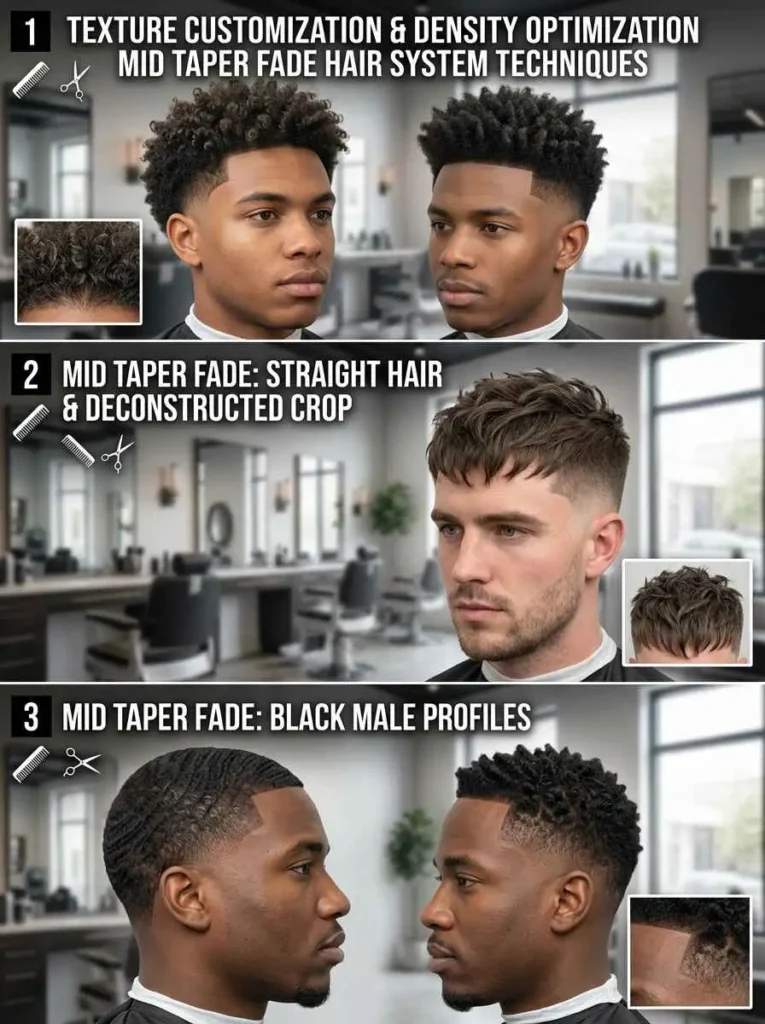
Mid Taper Fade Curly Hair Systems
Curls demand sufficient structural foundation to prevent unwanted horizontal flare. A mid taper fade curly hair profile removes the lateral bulk pushing out above the ear while keeping adequate length at the parietal zone. This structural weight anchors the curl canopy, allowing ringlets or coils to drape organically without collapsing into a boxy shape. Incorporate leave-in hydration creams to sustain curl definition against the clean skin transition.
Mid Taper Fade Straight Hair & Deconstructed Crops
Fine and straight strands naturally resist vertical lift. When designing a mid taper fade straight hair look, barbers utilize slide-cutting and point-cutting techniques across the crown to generate deliberate separation. Coupling a clean mid-level transition with a textured French crop or an off-center parted fringe establishes an intentional, dimensional contrast between the blunt perimeter and the chaotic interior texture.
Mid Taper Fade Black Male Profiles
Tightly coiled (Type 4) hair creates exceptional shadow-to-light gradients. A mid taper fade black male cut emphasizes crisp hairline delineation around the frontal temporal angle and C-cup curvature. Barbers often combine this mid-level taper with defined 360 wave alignment, sponge twist geometry, or crisp mini-locs. The skin graduation provides a razor-sharp frame without disrupting uniform wave depth across the crown.
Professional Barber Consultation Script
Vague requests lead to misaligned expectations in the chair. When ordering your mid taper fade, convey these precise technical benchmarks:
- Pinpoint the Initial Bald Line: Specify that your bald guideline must start precisely at the mid-point of the temple, following the subtle natural curvature of the skull rather than cutting a straight horizontal line.
- Define Graduation Finish: Clarify whether you prefer an open-foil razor finish (true skin) or a softer closed-lever zero (#0000 guard) shadow at the lowest perimeter.
- Preserve the Temporal C-Cup: Instruct your barber to retain natural density along the temple curve to preserve sharp line-up angles.
- Balance Crown Integration: Direct the stylist to connect the side graduation to the top using clipper-over-comb or shear-over-comb rather than running a high guard straight off the head.
Technical Execution Mistakes to Avoid
Barbershop visits often fail when basic architectural rules are ignored:
- Elevating the Guideline Too High: Setting the initial bald track above the temporal ridge inadvertently transforms the style into a high taper, sacrificing the intended side density.
- Over-Thinning the Parietal Ridge: Aggressively removing internal bulk near the upper corners creates an awkward flat shelf between the mid taper fade and the crown.
- Neglecting Scalp Anatomy: The occipital bone features natural depressions; clipper pressure must remain consistent across these contours to prevent dark, unblended patches at the neckline.
Maintenance Schedules & Follicle Care
Sustaining sharp perimeter contrast requires routine maintenance and conscious scalp hygiene:
- Days 1–5 (Peak Crispness): Skin boundary remains stark; line-up contours show razor precision.
- Days 6–12 (Shadow Phase): Micro-stubble emerges, softening the transition into a subtle gradient.
- Days 13–21 (Touch-Up Window): Perimeter growth begins blending into the upper guards. Schedule a perimeter clean-up or full appointment to reset the mid taper fade.
Keep the skin and scalp hydrated using non-comedogenic oils, and use a specialized comb or brush to stimulate healthy blood circulation without irritating newly shaved areas.
Frequently Asked Questions
What face shapes benefit most from this cut?
Round and square face structures benefit substantially. By removing side bulk directly at the temples, the cut visually slims wider cheeks and sharpens jawline angles without over-elongating the skull structure.
How does this style integrate with facial hair?
It pairs effortlessly. Your barber can execute an inverted drop down through the sideburn into the cheek line, creating a clean, disconnected transition between the scalp fade and the beard outline.
What styling product works best for everyday wear?
Water-based matte pastes and sea salt texturizing sprays yield optimal results. They establish workable hold and natural separation across the upper layers without depositing heavy, greasy residue that distracts from the clean taper work.