High Taper Fade: The Master Barber’s Technical Handbook
A pristine high taper fade is the hallmark of advanced clipper work. Unlike conservative drop cuts that leave safety weight around the ears, this aggressively tailored aesthetic demands absolute precision. By lifting the bald transition line to the upper temporal peaks and the high occipital region, barbers create a striking, disconnected illusion. The sides are eradicated, focusing the viewer’s eye entirely on the texture and volume at the crown. If you are preparing to upgrade your look from foundational barbering principles to something razor-sharp, this technical breakdown explains the mechanics, clipper systems, and styling protocols required to pull off this premium haircut.
The Architecture of a High Taper Fade Haircut
To understand why this cut looks so sharp, you have to look at how barbers manipulate cranial zones. A standard high taper fade haircut completely clears the sideburns and temple, pushing the zero-line up to the parietal ridge.
Instead of a standard halfway graduation, the stylist uses trimmers to carve a high baseline. The transition from bare skin to bulk happens rapidly over a very short vertical distance. This leaves the C-cup (the curved hairline near the eye) either completely shaved off or transformed into a razor-thin, floating arch. On the back of the neck, the graduation is pushed high up the nape, creating a crisp, aerodynamic slope that seamlessly meets the crown.
Formulating the Blend: Expert Clipper Mechanics
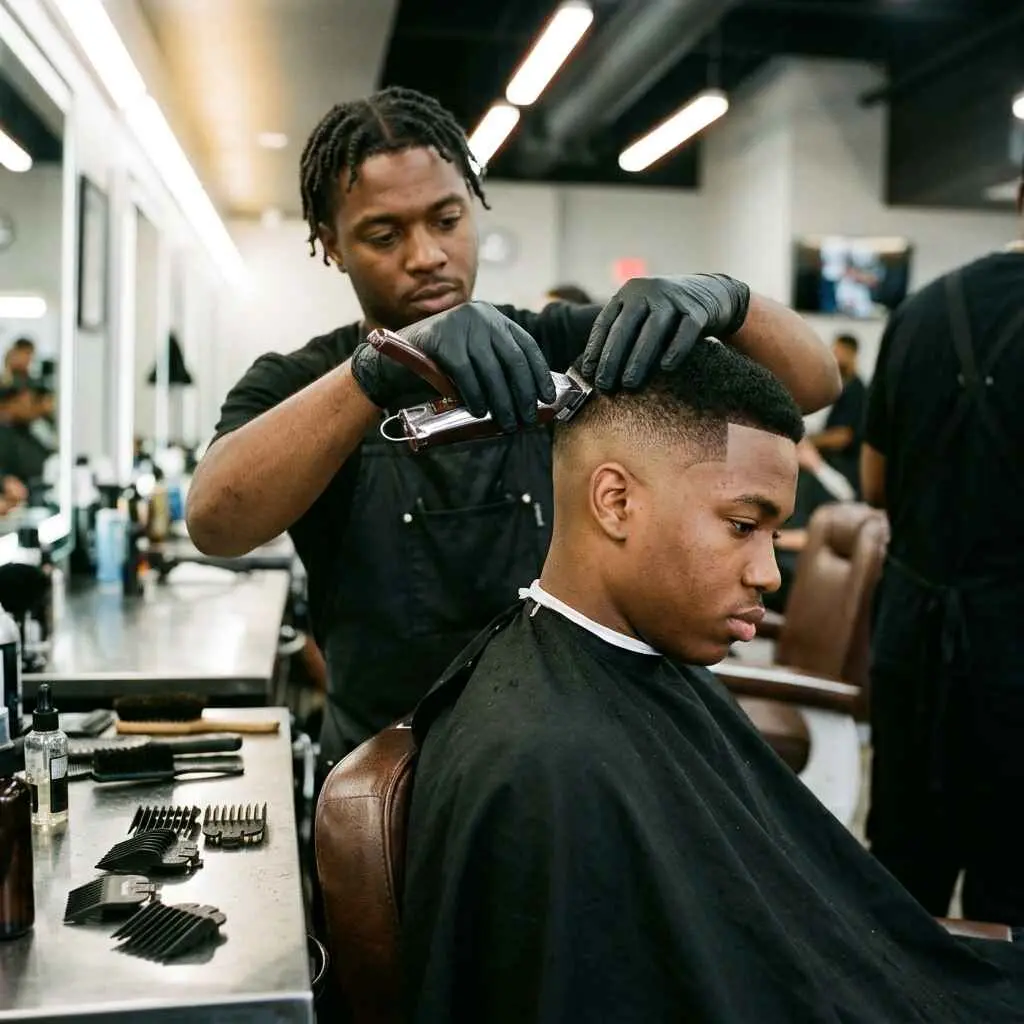
Achieving a flawless, buttery blend at this height requires a master understanding of clipper lever play.
- Setting the Canvas: The barber debulks the sides with a #2 or #3 guard to see the head’s natural shape.
- The Zero Line: Using zero-gapped trimmers, they stamp the initial bald guideline high up the temple. A foil shaver follows to take the bottom entirely to the skin.
- Lever Manipulation: The clipper lever is opened fully to create a half-inch buffer zone above the skin line for the high taper fade.
- Guard Stacking: By rapidly switching between the 0.5, #1, and 1.5 guards, the barber erases the weight lines, utilizing the corners of the clipper blade to detail the high-contrast transition.
Texture Protocols: Adapting to Your Genetics
A high graduation behaves differently depending on the genetic structure of your hair. Tailoring the top is what separates a decent cut from a masterpiece.
High Taper Fade Black Male Systems
For coarse, tightly coiled Type 4 hair, this style is legendary. The high taper fade black male aesthetic thrives on extreme contrast. Because the coils naturally stand upright, removing the lateral bulk prevents the head from looking too round. Barbers often combine this high-elevation skin work with 360 waves, short dreadlocks, or defined sponge twists. The rigid, high transition ensures the wave or loc patterns remain the absolute center of attention.
High Taper Fade Curly Hair Formations
Loose curls and ringlets need spatial control. The biggest mistake men with textured hair make is leaving too much bulk above the ears, resulting in an unwanted bell shape. A high taper fade curly hair profile solves this instantly. By taking the clippers all the way up the temporal ridge, the curls are forced to cascade forward and backward, rather than spilling outward over the ears. Apply a lightweight curl cream while the hair is damp to lock the ringlets together.
High Taper Fade Straight Hair Customization
Pin-straight hair is notoriously stubborn; it tends to stick straight out when cut short. Therefore, a high taper fade straight hair execution requires aggressive shear work. Barbers deploy thinning shears and point-cutting methods to shatter the ends of the hair on top. This allows the straight strands to lay flat or be swept up into a highly textured, messy fringe that effortlessly contrasts the bald temples.
Style Comparisons: High Elevation vs. Alternatives
When sitting in the chair, knowing what not to ask for is just as important.
- Vs. The Burst: Unlike rounded ear-arch styles that leave hair trailing down the neck, a high taper fade removes the back neckline completely.
- Vs. The Blowout: While vertical lift techniques focus on pushing the hair outward, this high fade focuses on carving the sides inward.
- Vs. The Low Drop: If you want to keep the sides thick, you should be asking for a cut focused on preserving weight at the base, rather than this high-elevation skin fade.
Silhouette Engineering for Face Shapes
Every time a barber removes hair from the sides of your head, they are changing your facial geometry.
- Round Faces: This is the ultimate corrective haircut for round cheeks. By removing the visual width from the sides of the head, the high graduation artificially lengthens the face, providing a chiseled, angular jawline.
- Square Profiles: The tight temples highlight strong bone structure, amplifying a squared-off, athletic jaw.
- Long/Oblong Faces: Proceed with caution. If your face is naturally long, erasing the side weight and adding height to the top will severely stretch your proportions. You are much better off choosing a lower fade variant.
The Consultation: Speaking to Your Stylist
Do not sit in the chair and use vague terms. Command your haircut by using this exact terminology:
- The Baseline: Ask for a high taper fade and specify that you want the foil shaver taken up to the corner of the hairline.
- The Neckline: Instruct the barber to match the nape fade to the height of the temples.
- The Transition: Request a “compressed blend.” Because the fade is high, the transition from skin to hair needs to happen tightly so it doesn’t thin out the top.
- The Crown: If you have straight hair, ask the barber to point-cut the top so it doesn’t look like a solid helmet sitting on top of a shaved head.
Frequently Asked Questions
How fast does a high taper fade grow out?
The cleaner the fade, the higher the maintenance. A bald transition at the upper temple shows regrowth immediately. You will lose the sharp skin contrast within 4 to 6 days. To keep the style looking premium, a 10 to 14-day touch-up schedule is mandatory.
Can I get this cut if my hairline is receding?
It is highly recommended for thinning corners. Because the high taper fade pushes the bald line right up to the recession point, it physically blends the thinning areas into the haircut, making a receding hairline look intentional and perfectly groomed.