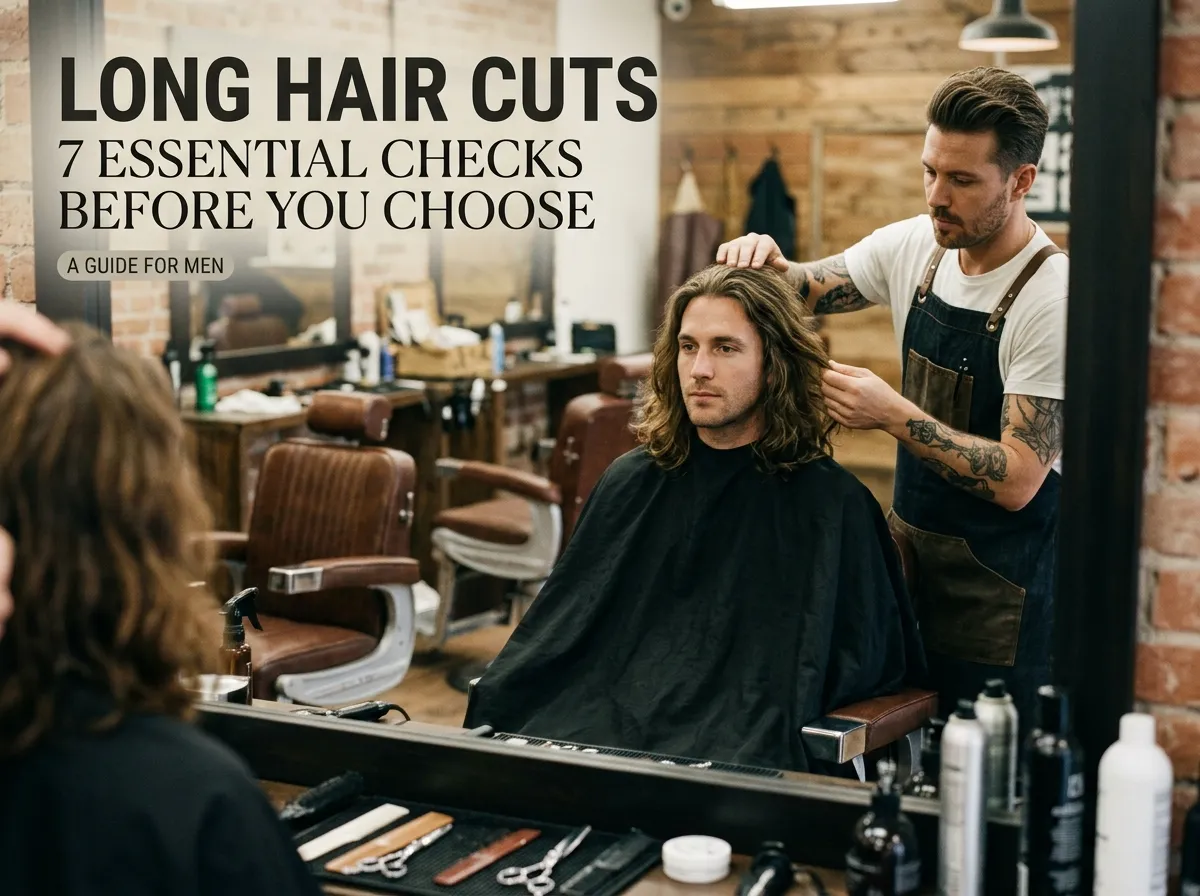
long hair cuts: 7 Essential Checks Before You Choose
The best long hair cuts match where you want volume, how your hair falls naturally, and how much care you will actually do. Round faces often benefit from controlled side volume; longer faces may benefit from width and a fringe. Those are starting points, not rules that exclude anyone from long hair.
Start with your face proportions, then check texture and density. A shoulder-length photograph cannot tell you how that cut will behave on your own hair.
Hair-health information here is general guidance, not a diagnosis. Seek professional advice for persistent scalp problems, suspected lice or unexplained hair loss.
1. Which long hair cuts suit your face shape?
Choose the shape around your face, not just the length below it. Layers are sections cut to different lengths; a fringe is hair shaped to fall across the forehead. Both can change where a cut appears full and how much forehead it exposes.
Treat the following as styling options. You do not need to hide a broad forehead or strong jaw if you like those features.
| Face shape | A useful starting point | Adjust if you want more balance |
|---|---|---|
| Oval | Collar-length hair or long layers | Avoid letting heavy front sections overwhelm the face |
| Round | Length below the jaw with controlled cheek-level fullness | Reduce bulky sides if they make the face look wider |
| Square | Long layers, waves or soft face-framing pieces | Change a heavy jaw-length outline if you want a softer finish |
| Oblong/rectangular | Collar-length waves, side fullness or a light fringe | Reduce excessive crown height and a very narrow silhouette |
| Heart | Softer front pieces and fullness nearer the jaw | Reduce high, bulky volume if it overemphasizes the upper face |
| Diamond | Soft framing with fullness near the forehead or jaw | Avoid placing all the volume at the cheekbones |
These suggestions interpret conventional proportion-based styling guidance from professional De Lorenzo material and University of Kentucky Extension. They are not scientifically guaranteed attractiveness formulas.
For help identifying your starting proportions, use our What Hairstyle Suits Me? guide.
When might the same length look wrong?
Volume placement can matter more than another inch of hair. Imagine two men requesting shoulder-length waves. One has a round face; the other has a narrow, rectangular face.
The first may prefer less fullness beside the cheeks. The second may prefer that side width and less height at the crown. Asking both for the same layers could produce two very different results. This is an illustrative consultation example, not a claim about a client.
2. How does your hair type change the choice?
Texture, strand thickness and density are separate checks. Texture describes straightness or curl pattern. Fine hair has thinner individual strands; low density means fewer hairs across an area of scalp. You can have fine strands and plenty of hair.
| Hair characteristics | Cut direction to discuss | Main trade-off |
|---|---|---|
| Straight, fine strands | A fuller perimeter with restrained layering | Too much removal may make the ends look sparse |
| Thick, straight hair | Long layers with controlled weight removal | Excess bulk can make the outline feel heavy |
| Wavy hair | Layers that work with the natural wave | The reference photo may depend on styling |
| Curly or coily hair | Shape assessed in its normal dry state | Shrinkage changes where the finished length sits |
| Low-density hair | A length and outline that preserve visible fullness | Extra length does not automatically conceal thinning |
Shrinkage is the difference between a curl’s stretched length and its natural length. Show your stylist how you normally wear your curls before agreeing on how much to remove.
Ask about layers that still reach your hair tie. Short face-framing pieces may look good loose but fall out when you exercise or work.
3. Which long hair cuts should you shortlist?
Choose two realistic cuts, then discuss the differences with your stylist. A bun or ponytail is a way to arrange hair, not a haircut by itself.
| Cut | Why consider it? | What to request |
|---|---|---|
| Collar-length cut | A manageable first step into longer hair | A clear dry-length target and a tidy outline |
| Long layered cut | Movement while retaining overall length | Layers placed around your texture and face |
| Long shag | A more textured outline with fringe options | Enough retained density at the ends |
| Shaped long curls | A deliberate silhouette around natural curls | Finished shape checked with shrinkage in mind |
| Long hair with a low taper | Cleaner edges while keeping substantial length | Exactly where the short section should stop |
A taper gradually shortens hair toward the edges. It does not require shaving away the entire side. Our low taper fade guide helps explain that option before you commit.
For parted front sections, compare our middle part hairstyle guide. A middle part is optional; changing the part can alter the framing without changing the whole cut.
4. What should you tell your barber or stylist?
Describe the finished dry result and your daily routine. “Keep it long” leaves too much room for interpretation. Bring front, side and back references with similar texture to yours.
Try this brief:
“I want the dry length near my shoulders, with enough hair to tie back. Keep the ends full, and show me where the shortest layers will sit. I want to wear it without daily heat styling. Please confirm how much you will remove before cutting.”
Then agree on the following:
| Decision | Question to ask |
|---|---|
| Length | Where will it sit when dry? |
| Layers | Will the shortest pieces still tie back? |
| Front | Will it fall across my eyes without styling? |
| Sides | Are we preserving fullness or adding a taper? |
| Upkeep | What styling will this shape actually need? |
Choose someone comfortable cutting your texture and longer shapes. A shop’s title matters less than the stylist’s relevant work.
5. How do you reduce breakage, tangles and split ends?
Protect the length through gentle handling and a routine suited to your scalp. Breakage means a hair shaft snaps; it is different from a hair shedding from the root.
The American Academy of Dermatology’s 2024 healthy-hair guidance recommends adjusting washing to oiliness and dirt, rather than imposing one schedule on everyone.
| Task | Practical approach |
|---|---|
| Washing | Concentrate shampoo on the scalp; wash when your scalp needs it |
| Conditioning | Apply after washing; focus on ends for fine/straight hair and lengths for dry curls |
| Detangling | Work gently from the ends upward with a wide-tooth comb |
| Drying | Absorb water with a towel or T-shirt instead of rough rubbing |
| Heat styling | Limit frequency, use lower heat and a heat-protection product |
| Securing | Avoid repeatedly pulling the hairline tight |
Wet-hair handling differs by texture. AAD advises letting straight hair dry somewhat before combing, while thick curls can be detangled with conditioner before rinsing. “Brush everything wet” is not a universal answer.
Do tight buns damage long hair?
Repeated tension can cause traction alopecia, a form of hair loss caused by pulling. AAD’s 2024 guidance identifies tight buns, ponytails and braids among the potential causes.
Loosen a painful style. Watch for broken hairs around the forehead, a receding hairline or patches where the hair is repeatedly pulled. A dermatologist can assess persistent changes. Longer hair does not justify tighter tying.
For split ends, ask your stylist what needs removing while preserving your length goal. Avoid treating a fixed trim interval as a growth rule; your condition and haircut shape matter.

6. Can long hair cause lice or nits?
Long hair does not create head lice, and clean hair does not guarantee protection. CDC guidance explains that lice mainly spread through direct head-to-head contact. Nits are lice eggs or their attached shells. Finding a live crawling louse is the best way to confirm an active infestation.
Reduce head-to-head contact with an infested person and avoid sharing combs, brushes or hair accessories. Routine shampooing or hair oil is not a substitute for checking and appropriate treatment.
What should you do if you find lice?
Use a suitable treatment according to its label, with professional advice when needed. CDC’s November 2024 treatment guidance notes that shoulder-length or longer hair may require more product for adequate coverage. Follow the directions; more frequent application is not automatically better.
Medication instructions can differ from normal hair care. CDC advises avoiding conditioner before lice medicine and following product-specific retreatment directions. Do not combine treatments or use household pesticide sprays.
Check household members and close contacts as directed. For identification and detailed next steps, read our early lice in hair guide. Oils and mayonnaise are not established substitutes for proven treatment.
7. Where did long hair become famous?
There is no verified single actor, film or country that invented men’s long hair. Older cultural practices and representations predate modern cinema. The Metropolitan Museum of Art holds Wenceslaus Hollar’s Head of young man with long hair in profile to the left, dated 1644–52. It documents an older example, not the first-ever wearer.
The modern fashion and screen connection
The Victoria and Albert Museum documents longer hair for men and women within late-1960s fashion. That helps explain a modern cultural shift without claiming the hairstyle began then.
For a recognizable screen reference, Chris Hemsworth’s Thor offers long and short versions of the same character. Marvel’s 2023 official interview includes discussion of those lengths. It is a useful reference point, not evidence that Thor created the look or caused the largest worldwide trend.
A movie image may also depend on professional styling or costume work. Bring the photo for its length, movement or outline; ask what is achievable with your own texture.
Which country likes long hair most today?
A reliable current country ranking was not established in the sources reviewed. Naming the US, South Korea or another country as the winner would overstate the evidence.
Google Trends explains that regional scores reflect relative search interest. They do not measure how many people wear long hair or prefer it. Country-level search comparisons would also need a defined date range and comparable search terms.
Frequently asked questions
Can a round face suit long hair?
Yes. If you want a less wide appearance, discuss controlled cheek-level fullness and length below the jaw. The cut’s outline matters more than a blanket face-shape rule.
Can men with long faces wear long hair?
Yes. Side fullness or a fringe can balance the visible length if that is your goal. Avoid automatically adding height just because a reference model wears it.
Should fine hair have lots of layers?
Not necessarily. Fine strands can benefit from preserving a fuller outline; discuss how much density the stylist will remove. Fine hair and low-density hair are different.
How often should men wash long hair?
Wash according to scalp oiliness, dirt and hair type. A fixed twice-weekly rule may not suit an oily scalp or someone whose routine makes their hair dirty more often.
Do you need to cut your hair short to treat lice?
A haircut is not the treatment plan. CDC guidance provides treatment steps for shoulder-length and longer hair; correct product coverage and directions still matter.
Choose your cut before choosing your product
Save two references with similar texture to yours. At the appointment, agree on dry length, layers, side volume and tie-back needs before the first section is cut.