
What Hairstyle Suits Me? 5 Smart Checks for Men
The hairstyle that suits you combines a shape you like with your natural hair and a routine you can maintain. If you’re asking “what hairstyle suits me?”, check your texture, density, growth direction, face proportions, and styling habits before choosing a haircut.
A quiff may give you the height you want but require more styling than you’ll do. Curtains may look appealing yet need front length you haven’t grown. Start with two realistic options, then ask your barber how each would work on your hair.
What Hairstyle Suits Me? Start With These Five Checks
Look at your hair on an ordinary day, without special styling. That gives you a better starting point than a photo taken straight after a salon blowout.
Use this worksheet before browsing haircut references.
| Check | What to notice | How it helps |
|---|---|---|
| Natural texture | Does your hair fall straight, form waves, curl, or coil? | Choose references with a finish your hair can realistically achieve. |
| Density | Is your coverage dense, moderate, or visibly sparse in places? | Discuss how much fullness to preserve. |
| Growth direction | Does the front lift, part naturally, or change direction at the crown? | Check whether the fringe and part will cooperate. |
| Preferred shape | Do you want height, fuller sides, forehead coverage, or an exposed hairline? | Narrow down the silhouette you like. |
| Upkeep | Will you use a dryer? How often will you book trims? | Eliminate styles that demand a routine you won’t follow. |
Write down one nonnegotiable preference, too. It might be keeping your ears exposed, avoiding daily heat styling, or retaining enough length to push the front back.
That preference often narrows the choice faster than knowing your exact face shape.
How Do You Estimate Your Face Shape?
Move your hair away from your face and look straight into a mirror. Compare your face length, forehead width, cheekbone width, and jaw outline. Use the closest category as a starting point, then check your natural texture and preferred haircut shape before deciding.
You don’t need a precise label to choose a haircut. Face-shape categories describe broad proportions; they aren’t rules about what you’re allowed to wear.
Use Face Shape to Choose an Effect
| Approximate shape | What you may notice | An adjustment to discuss |
|---|---|---|
| Round | Similar length and width, with a curved jaw | More front height if you want a longer-looking outline |
| Square | A pronounced jaw and relatively straight sides | Loose texture for softness, or a cleaner outline to emphasize the angles |
| Oval | More length than width, with a gently narrowing outline | Start with texture and upkeep rather than a corrective goal |
| Oblong | A noticeably long outline | Less top height or a fringe if you want less visible length |
| Heart | A wider forehead narrowing toward the chin | A side-swept front or some retained side fullness |
| Diamond | Cheekbones wider than forehead and jaw | Adjust fullness around the temples and front |
| Triangular | A jaw wider than the forehead | Compare fuller upper sections with tighter sides |
These are optional visual effects. You might like a buzz cut because it exposes your face, even when a guide recommends adding height.
What if You’re Between Two Shapes?
Skip the argument over the label. Describe what you see and what you want to change.
“I’d like less height on top” gives a barber a clearer instruction than “I think I’m oval, but possibly oblong.”
Include your usual facial hair in the reference. If you plan to keep a beard, judge the haircut alongside it rather than imagining a clean-shaven version of yourself.
Which Men’s Haircuts Should You Shortlist?
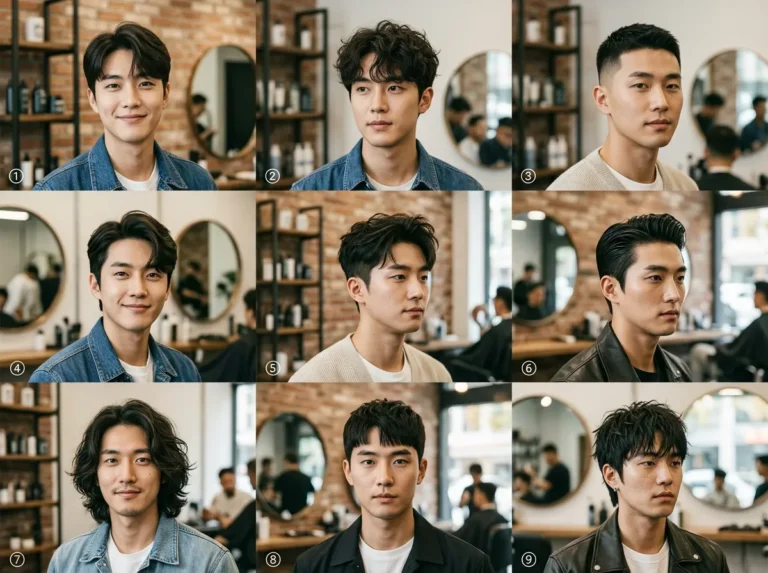
Choose a haircut family first, then adjust its details. Fringe length, side fullness, parting, and styling can change the appearance of the same named cut.
| Haircut | What defines it | Consider it when you want | Check before choosing |
|---|---|---|---|
| Crew cut | A short top, usually longer toward the front | A compact shape with limited styling options to manage | Crown growth and preferred side length |
| Textured crop | A shorter top with separated texture and a forward fringe | A defined front without long curtains | Where the fringe will sit when dry |
| Side part | The top directed to one side | Forehead exposure and a tidy outline | Your natural part and desired shine |
| Quiff | The front lifted upward | Visible height at the front | Whether you’ll shape it regularly |
| Curtains | A longer fringe divided around a part | Movement around the forehead | Enough front length and a workable part |
| Two-block | A longer upper section over shorter sides and back | A longer top with a tidier lower outline | How much contrast you want underneath |
| Longer layers | Different lengths creating movement through longer hair | Length around the ears or neck | Dry shape, fullness, and detangling needs |
| Curly or coily tapered cut | More length on top, gradually shorter edges | Natural texture with a shaped outline | Finished length after the hair dries |
A taper gradually shortens the hair toward the edges. A fade blends between lengths; a skin fade takes its shortest section down to the skin.
Don’t request a fade merely because your reference has neat sides. You may prefer a softer taper with less scalp visible.
How Does Your Hair Type Change the Choice?
A reference photo should help explain the shape, but your hair determines how to build it. Two men can request curtains and need different lengths, layers, or styling methods.
Straight, Wavy, Curly, and Coily Hair
For straight hair, ask how the front will hold the movement shown in your reference. If the look relies on waves, establish whether those would require styling or a treatment.
With wavy hair, compare the cut’s natural finish with its brushed or blow-dried finish. Choose the version you expect to wear most days.
For curls and coils, agree on the finished length and outline when dry. Hair can appear longer when stretched or wet, so “take off an inch” may not fully explain the result you want.
Fine Strands Aren’t the Same as Low Density
Strand thickness describes the size of an individual hair. Density describes how closely the hairs grow together.
You can have fine strands and dense coverage, or coarse strands with less coverage. Those combinations call for different conversations.
If coverage concerns you, ask what the cut will preserve before agreeing to thinning. Explain whether your priority is reducing bulk, creating separation, or keeping the front looking full.
Check Cowlicks and Your Hairline
A cowlick is an area where hair grows in a different direction from the surrounding strands.
Point out the front section that lifts or the crown that refuses to sit flat. Ask the barber to examine it before washing and cutting.
If your hairline is receding, decide whether you want to show it or soften its appearance with the front section. Request a realistic dry finish rather than relying on a densely styled photo.
A haircut changes appearance; it doesn’t treat hair loss. For sudden shedding, scalp irritation, or patchy loss, seek medical advice.
How Much Maintenance Will the Haircut Need?
Daily styling and appointment upkeep are separate commitments. A very short cut may need little work each morning while requiring regular visits to retain its exact outline.
| Your preference | What to discuss |
|---|---|
| Minimal morning styling | A shape that sits well after your normal washing and drying routine |
| Willing to use a dryer | How to create the part, front height, or fringe curve |
| Fewer salon visits | A cut whose softer grown-out appearance you still like |
| A consistently sharp fade | A touch-up schedule and cost you can maintain |
| Natural curls or coils | A routine suited to your texture and chosen length |
Ask: “What will this look like if I don’t blow-dry it?”
That question separates the haircut from the salon finish.
For heat styling, the American Academy of Dermatology’s 2024 guidance recommends limiting heat exposure, using low or medium settings, and applying an appropriate heat-protection product. A haircut that requires more heat than you want to use is worth reconsidering. American Academy of Dermatology
Can You Test a Hairstyle Before Cutting?
Test the part and styling direction first; use photo previews to compare appearance. Neither replaces an assessment of your actual hair.
Compare Suitable Reference Photos
Save photos that resemble your texture and coverage. Include a front view and a side view where possible.
Check what attracts you to the image. Is it the cut, the waves, the hair color, or the model’s overall styling? A haircut appointment may only change one of those things.
Look for ordinary finished hair as well as carefully styled photographs.
Try a Smaller Change
Before committing to a shorter fringe, experiment with your current part. Try directing the front forward, sideways, or back.
This won’t reproduce every haircut, but it can clarify whether you enjoy forehead coverage or an exposed front.
If you use a digital hairstyle preview, treat the image as an illustration. It doesn’t establish how the cut will behave with your density, growth patterns, or home routine. Check the service’s photo-handling policy before uploading.
Three Examples of Choosing a Suitable Haircut
The following are hypothetical decisions, not personal experiences or guaranteed results.
Example 1: Fine Straight Hair and Little Styling Time
You like a tall quiff but don’t want to use a dryer each morning.
Shortlist a shorter side part and a textured crop instead. Ask the barber to show how each sits without lifting the roots.
Keep the quiff as an option if the demonstrated routine feels manageable. The decision is about the work you’ll do, rather than whether fine hair can wear a quiff.
Example 2: Dense Wavy Hair With a Front Cowlick
You want curtains, but one side of the front naturally lifts.
Ask whether an off-center part could work with that direction. Compare it with a looser side-swept fringe before requesting a perfectly symmetrical middle part.
The barber should assess the growth pattern and retained length. Don’t assume stronger product will solve the mismatch.
Example 3: Curly or Coily Hair With a Natural Finish
You want a cleaner outline while keeping your texture.
Compare a tapered shape with a fuller layered outline. Discuss the dry top length, how much side fullness to retain, and whether you’re comfortable showing scalp at the edges.
Choose using the natural finished shape, rather than a reference that depends on stretching or straightening.
What Should You Tell Your Barber?
Describe the result and your routine before naming the cut. Bring one preferred reference and one simpler alternative.
Chicago Male Salon’s June 2026 guide describes a consultation that considers texture, density, growth patterns, lifestyle, and previous haircut problems alongside facial proportions. Those are useful details to bring to your own appointment. Chicago Male Salon
Try this script:
“I like the front shape in this photo and the side length in this one. My hair naturally moves this way, and I usually style it with [your actual tools and products]. Please tell me what needs adapting and show me the finished routine.”
Before cutting, confirm:
- Where the fringe will sit when dry.
- How much scalp will show at the sides.
- Which lengths you want to keep.
- Whether the reference needs a perm or regular heat styling.
- What the cut will look like without the salon finish.
Photograph the finished front and sides if you like the result. At your next visit, explain which details worked and which became difficult as the hair grew.
Frequently Asked Questions
Is Face Shape or Hair Texture More Important?
They answer different questions: proportions help you choose the visual effect, while texture affects how the cut behaves. Check both before committing to a reference.
Should I Choose Short or Long Hair?
Choose based on the outline you like and the care you’ll maintain. Short hair can require frequent shape touch-ups, while longer hair brings different washing, drying, and detangling needs.
Why Doesn’t My Haircut Look Like the Photo?
The reference may have different density, growth direction, or professional styling. Ask which features your barber can reproduce and which need adapting.
Can a Hairstyle App Choose My Haircut?
It can help you compare illustrated looks. Use the result as a discussion aid and ask a barber to assess whether the shape is practical.
Take Two Realistic Options to Your Barber
Choose two references that fit your texture and routine. Mark the fringe, side length, and finish you like, then ask your barber to help select the version you can maintain.