10 Korean Hairstyles for Men: Find Your Best Fit
If you’re searching for a “korean men hairstyle,” start with your natural texture and the amount of styling you’ll actually do. A two-block haircut gives you a longer top with shorter sides and back. Curtains create a parted fringe, while comma hair adds a curved front section. A perm is optional, depending on the finish you want.
Choose the shape first. Then bring clear reference photos to a barber who can adapt it to your hair, rather than copying a celebrity’s finished look without discussing how it was styled.
Korean Men Hairstyle Guide: Which Look Should You Choose?
Pick a style you can recreate after the salon blowout. Hair density, growth direction, and current length matter alongside face shape.
Hair texture describes whether your strands are straight, wavy, or curly. Density means how closely those strands grow together. Fine strands can still form a dense head of hair, so “fine” and “thin” don’t mean the same thing.
| What you want | Styles to discuss | What to check before cutting |
|---|---|---|
| Shorter hair with less fringe styling | Textured crop | Where the fringe will sit when dry |
| A longer top with tidy sides | Two-block | How much side contrast you want |
| A visible middle part | Curtains | Whether your front section naturally separates |
| A curved, lifted fringe | Comma hair | Whether you can create the curve without a perm |
| A neat look with the forehead partly open | Side part | Your natural part and preferred finish |
| Longer layers around the ears and neck | Soft wolf cut | How much back length you’re willing to keep |
| Movement through the top | Wavy two-block | Whether your existing waves provide enough shape |
Treat face-shape suggestions as styling options. If you want more visible height, discuss lifting the front. If you prefer less height, consider a fringe that sits closer to the forehead.
10 Korean Hairstyles for Men to Show Your Barber
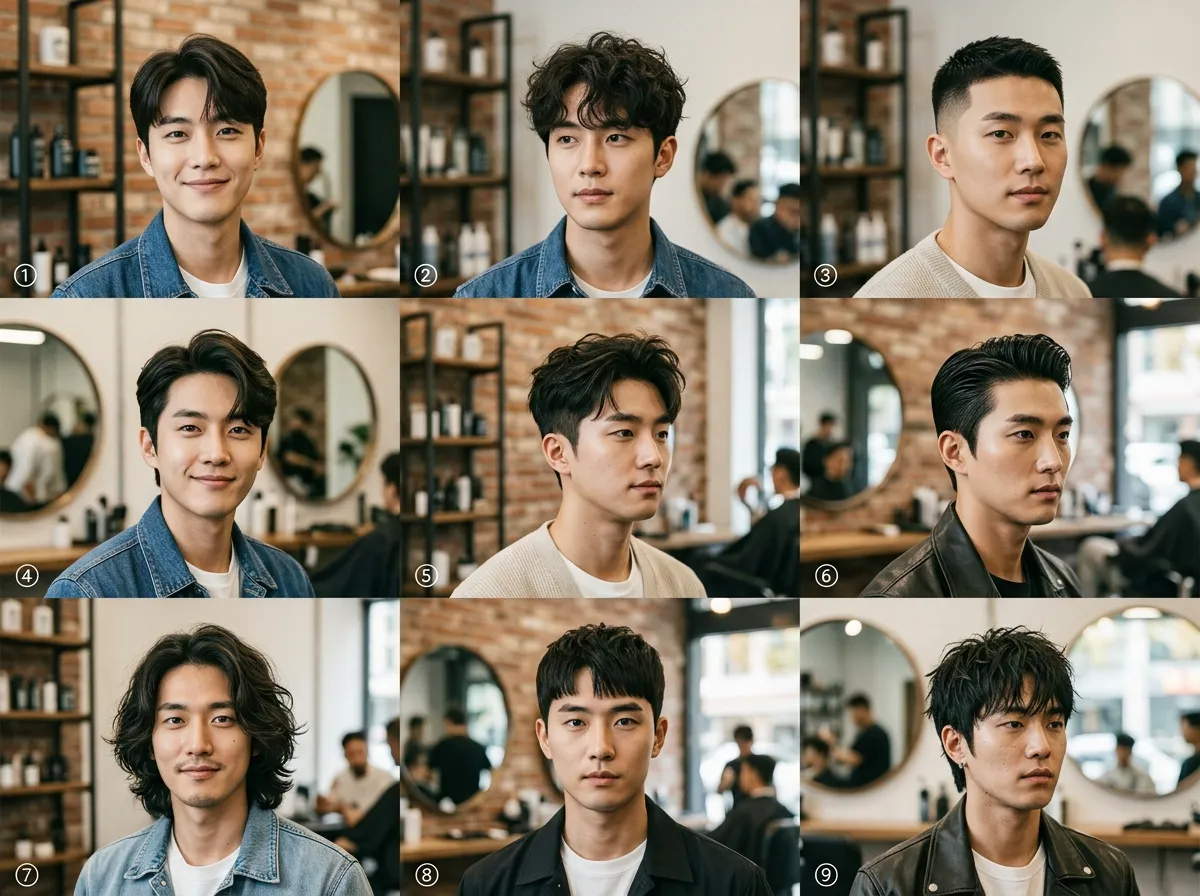
These options include cuts, fringe styles, and textured finishes. Several can share the same underlying haircut, so tell your barber which parts of the photo you want.
1. Two-Block Haircut
A two-block haircut separates a longer upper section from shorter sides and back. You can wear the top forward, parted, or swept away from your forehead.
Ask: “Keep the top long enough for this fringe, with shorter sides underneath. Please show me how much of the shorter section will be visible.”
Confirm the side length before the clippers start. A photo with hair covering the sides can hide more contrast than you expect.
2. Curtain Fringe
Curtains are a fringe divided into two sections, usually around a middle or slightly off-center part.
Ask: “Keep enough front length for curtains, with the ends falling like this photo. I’d like the part to work with my natural growth direction.”
Check where the fringe lands when dry. Don’t choose its length solely from how wet hair hangs during the appointment.
3. Comma Hair
Comma hair has a front section shaped into a curve resembling a comma. It describes the styling, rather than one specific haircut.
Orange & Teal’s September 2026 guide explains that comma styling can sit over a two-block or another suitable cut. Ask: “Keep enough fringe length to create this curve, and show me how to style it.”
4. Dandy Cut
A dandy cut usually refers to a neat shape with a soft fringe and controlled sides, but salons may interpret the name differently.
Ask: “I want this rounded front shape, a tidy outline around the ears, and this amount of forehead coverage.”
Use the photo to define the request. The label alone doesn’t settle the fringe length or how closely the sides should be cut.
5. Textured Fringe
A textured fringe uses separated sections rather than one solid line across the forehead. It can be worn over shorter sides or a fuller outline.
Ask: “Keep the fringe at this level, with visible separation rather than a heavy straight edge.”
If your front already looks sparse, ask how the barber will create texture while preserving coverage.
6. Korean-Inspired Side Part
This option keeps the top directed to one side, with the forehead partly visible. The sides can be tapered or left fuller.
A taper means the hair gradually gets shorter toward the edges.
Ask: “Follow this part and front shape, with a natural finish. I don’t want a shaved part line.”
Discuss the finish too: a soft brushed shape and a glossy, tightly combed look can read very differently.
7. Short Textured Crop
A textured crop combines a shorter top with a defined fringe and visible separation. It’s an option if you like Korean-inspired styling but don’t want longer curtains.
Ask: “Keep a short fringe and a textured top, with this outline around the ears.”
Choose the fringe position carefully. A very short front won’t give you the same styling options as a longer two-block.
8. Layered Bowl Cut
A bowl cut has a rounded outline around the head. Layers can change how solid or separated that shape looks.
Ask: “I like the rounded silhouette, but I want this amount of texture and these ears visible.”
Show both the front and side view. You may like the fringe in one photo while wanting less fullness around the temples.
9. Soft Wolf Cut
A wolf cut combines layers with a longer back and a less uniform outline. The softer version keeps those changes less dramatic.
Ask: “Keep this length at the neck and around the ears, with layers that create this shape.”
It’s a useful choice when the longer outline is part of what you like. If you want the neck and ears fully exposed, choose a different reference.
10. Wavy Two-Block
A wavy two-block pairs shorter lower sections with movement through the longer top. That movement may come from natural waves, styling, or a perm.
Ask: “Can my current texture create this finish? Please explain which parts would need daily styling or a treatment.”
Start by assessing the waves you already have. Don’t book a perm simply because the reference photo looks wavy.
How Do You Ask Your Barber for a Korean Haircut?
Bring reference photos showing the front, side, and back. Explain which details you like: fringe position, exposed ears, side contrast, and neckline. Ask whether the finished look requires blow-drying, a perm, or more length than you currently have. Confirm those choices before the haircut begins.
Describe the Shape, Not Just the Name
In a US barbershop or salon, a plain description helps clarify unfamiliar style names.
Try:
“I want this longer top and parted fringe, with shorter sides underneath. Keep the front long enough to fall like the photo. Please avoid a skin fade, and show me how to style it with a dryer and light product.”
A skin fade takes the shortest section down to the skin.
Choose reference photos with similar texture and density to yours. You can still use a different reference for inspiration, but ask what would need to change.
Request a Styling Demonstration
Before leaving, ask the barber to show you the parting, drying direction, and amount of product.
Watch the process. If they use a round brush or styling iron you don’t own, ask for an alternative or decide whether you’re willing to learn that method.
[For example, “short sides” leaves room for interpretation. If you want a soft two-block with curtains, explain that the longer top should cover the shorter sides and the fringe should remain long enough to part. Ask the barber to confirm the side length before cutting and demonstrate the finish with the tools you have at home.]
Do You Need a Perm for Korean-Style Hair?
No, a Korean-inspired haircut doesn’t automatically require a perm. A perm is a chemical treatment used to change the hair’s shape. It may help create movement, but the decision depends on your existing texture and desired finish.
Miin Hair & Beauty’s guide, updated in May 2026, distinguishes the haircut from comma styling and discusses achieving the curve with a dryer and brush.
| Option | What it addresses | What to ask |
|---|---|---|
| Cut and daily styling | Shape created temporarily at home | “Can you demonstrate this without a perm?” |
| Wave or fringe perm | Added bends through selected sections | “What will it look like without salon styling?” |
| Down perm | Side hair that projects outward | “Is this suitable for my hair and treatment history?” |
A down perm aims to make selected hair lie flatter; it serves a different purpose from adding waves through the top.
Tell the stylist about previous bleach, coloring, or chemical treatments. Ask for an assessment before committing. Avoid promises that a perm will remove all styling or withstand every weather condition.
[Before choosing a perm, ask whether you need movement through the top or flatter sides; those are different goals. Describe any previous coloring or chemical treatments, then request a hair assessment and clear aftercare instructions. Wella Professionals’ 2022 guidance recommends a consultation before perming and notes that the treatment creates a new styling base rather than removing the need to style.]
How Do You Style Korean-Inspired Hair at Home?
Shape the hair before adding more holding product. For curtains or comma hair, the drying direction is part of the finished look.
Start With a Simple Routine
| Step | What to do |
|---|---|
| Prepare | Gently towel-dry and let the hair partially air-dry. |
| Find the part | Separate the front where you want it to sit. |
| Create the shape | Use gentle airflow and fingers or a suitable brush to guide the fringe. |
| Check the result | Look at the front and sides before adding product. |
| Finish | Use a small amount of a product suited to your desired hold and shine. |
The American Academy of Dermatology’s undated guidance, accessed in October 2026, recommends partially air-drying hair and limiting heat exposure. It also warns that excessive heat can damage any hair type.
Fix the Problem You Can See
| Problem | First thing to check |
|---|---|
| Fringe falls flat | Whether you’re shaping the roots while drying |
| Curtains don’t separate | Whether the part conflicts with your growth direction |
| Hair looks greasy after styling | Whether you’re using too much product or an unwanted glossy finish |
| Sides stick out | Whether a different side length or cut would help |
| Layers look unlike the photo | Whether the reference depends on waves or professional styling |
Change one part of the routine at a time. That makes it easier to see what helps.
[INTERNAL LINK: hair clay versus paste versus pomade]
[For a practical styling trial, start with a small amount of your chosen paste or cream, following its directions. Shape the fringe first, then check the finish before adding more. If it looks greasy or overly shiny, try less product at the next wash rather than changing several parts of the routine at once.]
What Should You Budget for the Cut and Upkeep?
Get a quote for the exact service you need. A haircut, fringe perm, and down perm are different appointments, and a single price wouldn’t represent US, UK, Canadian, and Australian salons accurately.
Ask whether the quote includes washing, drying, styling instruction, and the treatment you discussed. Check whether prices vary by stylist or hair length.
For upkeep, choose the point at which the shape stops working for you. Short exposed sides may need attention before a longer layered outline does. Ask whether you can book a fringe or side trim between full cuts.
Frequently Asked Questions
What Is a Korean Haircut Called?
There isn’t one universal name. Two-block, curtains, comma hair, and dandy cut describe different shapes or styling choices, so bring a photo alongside the name.
Can You Get Korean-Inspired Hair Without Straight Hair?
Yes, but the cut should accommodate your waves or curls. Ask for a version that uses your texture and check the fringe position when dry.
How Long Does Your Hair Need to Be?
It depends on the style and how the front will sit. Show the desired finish and ask whether you have enough length now or should grow selected sections before cutting.
Are Korean Hairstyles Suitable for Fine Hair?
Some can be adapted to fine hair, but density and coverage matter too. Discuss how much layering or separation to add before removing weight.
Can You Get Comma Hair Without a Perm?
Yes, styling can create the curve. Ask your barber to demonstrate it on your hair so you can judge the tools and effort involved.
Take Your Reference Photos to the Next Appointment
Save one preferred look and one simpler alternative. Ask your barber which suits your current hair, then agree on the fringe, sides, and home routine before cutting.