
Middle Part Hairstyle for Men: Is It Right for You?
A middle part hairstyle is worth trying if you want face-framing hair with movement and you’re willing to keep enough length in the front. Straight and wavy hair can form recognizable curtains; curls need a different shape and enough dry length. The main drawbacks are styling effort, fringe falling into your eyes, and a precise split that may fight your natural growth.
Your face shape matters, but the cut matters too. Before copying an actor’s photo, compare the fringe length, side volume, and texture with your own.
What is a middle part hairstyle?
A middle part separates your hair near the center of your head. Curtains are the front sections that hang on either side of your face, often with this parting.
The part is a styling choice; the haircut supplies its shape. You can combine it with blended sides, a low taper, a fade, or longer layers. A taper gradually shortens the hair, often around the edges; a fade creates a more pronounced transition through short lengths.
Why choose it, and what are the drawbacks?
| Benefit | What it means for you |
|---|---|
| Face-framing front | You can position the fringe around the forehead or cheekbones |
| Several side options | Keep softer sides or choose stronger contrast |
| Works with visible texture | Waves and curls can become part of the look |
| Adjustable part placement | A slight shift can accommodate natural growth |
| Flexible finish | Wear it loose or more neatly arranged |
It isn’t automatically a wash-and-go cut. The effort depends on how readily your hair separates and dries into place.
| Drawback | When it matters | Possible adjustment |
|---|---|---|
| One side lifts or folds differently | A cowlick resists the split | Try an off-center part |
| Roots look flat | Fine strands or heavy product | Reduce product and adjust drying |
| Fringe gets in your eyes | Longer curtains fall forward | Change finished length or direction |
| Side volume feels too wide | Dense hair or an unsuitable shape | Ask the barber to reshape the sides |
| Daily resetting is needed | Sleep or drying disturbs the front | Dampen only the affected sections |
| Close sides need upkeep | You choose a fade | Pick blended sides if that suits your routine |
Heat styling adds another trade-off. The American Academy of Dermatology’s undated guidance, reviewed in October 2026, recommends air-drying when possible and using the lowest heat setting.
[American Academy of Dermatology hair-care guidance]
Which face shapes suit a middle part hairstyle?
Choose the proportions you want to emphasize, then adjust the cut. Face-shape categories are visual guides, not rules that decide whether you’re allowed to wear curtains.
Man of Many’s May 2026 guide recommends adjusting height and side volume: rounder faces may benefit from more lift and narrower sides, while longer faces may suit softer curtains with less height.
| Face shape | Starting option to discuss | Use caution with | Reason |
|---|---|---|---|
| Oval | Soft curtains or a moderate taper | A fringe that hides more face than you want | You have room to experiment with proportions |
| Round | Controlled side volume with some root lift | Very full sides at cheek level | Extra side width may emphasize roundness |
| Long or oblong | Lower-volume curtains with some side fullness | Tall roots and extremely tight sides | That combination can emphasize length |
| Square | Soft bends and a less rigid split | A blunt, angular outline if you want softness | Softer edges can contrast with a strong jaw |
| Heart-shaped | Face-framing pieces with balanced sides | Excessive upper-side fullness | Test how the cut frames a wider forehead |
| Diamond-shaped | A softer outline around the temples | Fringe ending at the widest cheekbone point | The ending point changes where width is emphasized |
When might it look less flattering?
A flat center split with bulky sides may disappoint someone seeking a narrower-looking silhouette. A tall top with a close fade may feel unbalanced on someone who wants to reduce the appearance of facial length.
Change the version before rejecting the entire style. Compare a softer split, different fringe length, or less side contrast in photos taken from the same angle.
Which hair types can form this look?
Straight and wavy hair are useful starting points for a classic curtain shape. Curly and coily hair can also be center-parted, but the result should follow the curl pattern rather than imitate straight strands.
Fine refers to strand width; density is how closely hairs grow. Shrinkage is the shorter appearance of contracted curls.
| Hair characteristic | Useful approach | Main limitation |
|---|---|---|
| Straight | Keep enough front length to bend and separate | Short, resistant strands may spring upward |
| Wavy | Let the wave shape the curtains | Each side may settle differently |
| Curly | Plan the cut around curls when dry | Shrinkage affects finished length |
| Coily | Discuss a shaped, center-parted curl silhouette | A straight-curtain photo may be a poor reference |
| Fine strands | Preserve fullness and use light product | Heavy formulas can reduce movement |
| Dense hair | Shape bulk selectively | Unplanned thinning can change the outline |
Do not assume thick hair needs aggressive thinning. Ask your barber which areas need shaping and which need enough weight to fall into place.
[hairstyles for wavy and curly hair]
How long does your hair need to be?
For conventional men’s curtains, roughly 4–6 inches on top is a useful discussion range, not a universal minimum. Your front length and finished position matter more than a single measurement.
StyleX Magazine’s July 2026 guide suggests 4–5 inches for shorter curtains, while Forte Series’ undated guide gives 4–6 inches. Their ranges are styling guidance, not evidence that shorter versions cannot work.
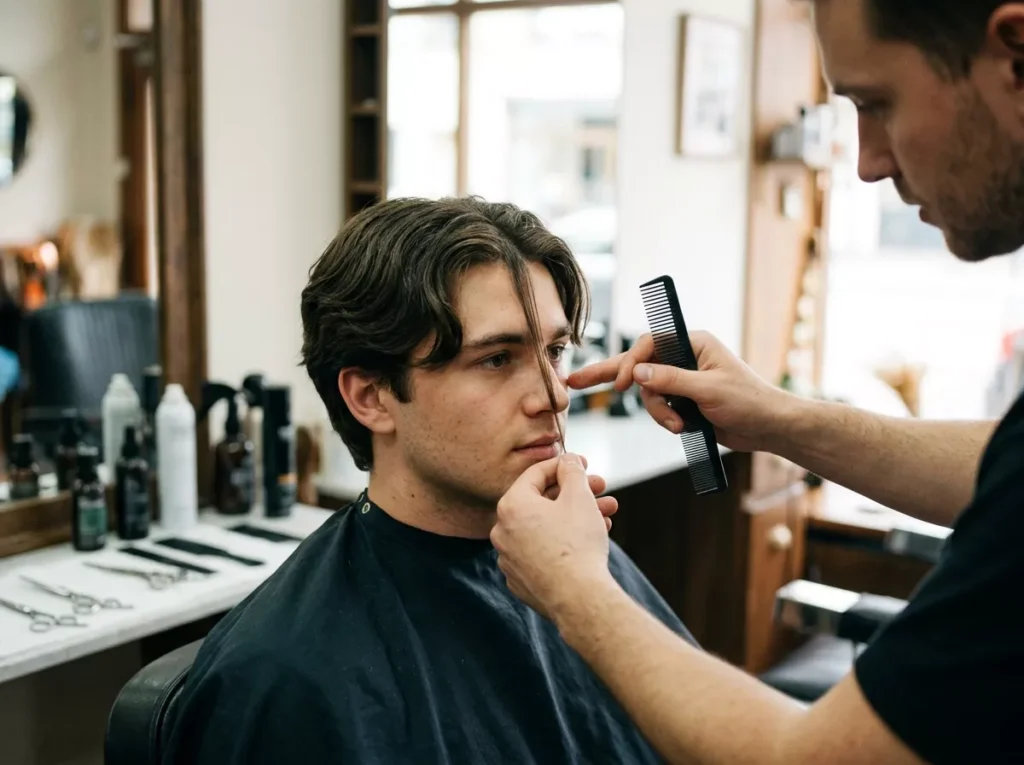
| Intended result | Landmark to discuss |
|---|---|
| Short, soft curtains | Front pieces near the eyebrows when styled |
| More visible face framing | Fringe extending toward the cheekbones |
| Longer flow | Enough length to move behind the ears |
Try separating the front while damp, then check it dry. If it cannot fall to either side, ask whether you need more length instead of buying stronger hold.
Where did it become famous, and which actors wore it?
The familiar men’s curtains look became strongly associated with 1990s pop culture. That describes a period of popularity, not the invention of center-parted hair.
Truefitt & Hill’s historical overview, published in 2021, credits Leonardo DiCaprio and Johnny Depp with helping popularize the face-framing style. This older source is used for stable historical context.
| Celebrity reference | What to look at |
|---|---|
| Leonardo DiCaprio’s 1990s curtains | The longer front and soft face-framing split |
| Johnny Depp’s 1990s curtains | How a looser finish changes the feel of the cut |
| Charles Melton’s wavy middle part, pictured in Man of Many’s 2026 guide | How natural bends supply movement |
| David Beckham’s earlier curtains, documented by GQ in 2015 | Another historical reference from sport rather than film |
These are documented looks, not claims about what each person wears today. Take a photo of a specific appearance to your barber instead of asking for an actor’s haircut by name.
What kind of person might choose it?
It can appeal to someone who likes retro styling, softer face framing, or medium-length movement. Those are style preferences, not demographic findings.
A short curtain version may suit someone wanting a tidier front; longer flow may appeal to someone comfortable with hair around the ears. Your routine is a better guide than your age or job. There’s no need to assign the haircut a personality.
What does real barber experience tell us?
Calgary barber Wesley Cheung’s undated guide explains how natural growth can make symmetrical styling harder. He suggests an off-center part when a strict middle line creates resistance.
The practical lesson is to test your own hair. Lightly dampen it, guide it back, and let it settle forward. Compare a center split with a slightly shifted one.
How do you ask for and style the cut?
Specify the fringe, sides, and effort you can manage. Try:
“I’d like soft curtains that sit around my eyebrows when styled, with blended sides. Please check my natural part and show me a routine I can repeat at home.”
To style a middle part hairstyle, gently arrange damp hair near the center and guide the front to either side. Air-dry for a softer finish or use low heat to shape the roots. Add a small amount of suitable styling product if needed, and shift the split if natural growth resists it.
| Step | What to do |
|---|---|
| Prepare | Blot excess water and detangle gently |
| Set the part | Use fingers to separate the front near the center |
| Choose drying | Air-dry for a softer finish, or shape gently with low heat |
| Arrange each side | Guide the front into the desired direction |
| Finish | Add a little suitable product only if needed |
Follow heat-protectant instructions if using heat. A diffuser spreads airflow and can help you dry curls without brushing them straight.
What if the result goes wrong?
If one side sticks up, re-dampen that area and test a shifted split. If the hair looks greasy, reduce product next time. If the sides puff outward, show the unstyled shape to your barber.
Change one thing at a time. Take comparable photos so you can judge the result.
Frequently asked questions
Can you get a middle part with a cowlick?
Often you can, but a cowlick may affect symmetry and effort. A cowlick is a section that grows in a different direction; test a slightly off-center split if it resists the line you want.
How long does it take to train hair into a middle part?
There isn’t a dependable timeline for everyone. Repeated styling may improve your routine, but it doesn’t permanently change follicle growth direction.
Is a middle part suitable for a receding hairline?
It depends on the appearance you prefer and how the fringe falls. Test it without pulling the front tight; changing a part can alter presentation, but it doesn’t treat hair loss.
Is a middle part better than a side part?
Neither is inherently better. Compare them on dry hair and choose the finish you prefer and can maintain.
Test the split before cutting, choose a reference with similar texture, and ask your barber to plan the finished dry shape.